Step 1 – Search the location and region
Before you start looking at houses, take a moment to understand the different regions and how life changes from place to place. Generally speaking, the south is warmer and life moves slower.
The north is cooler, better connected, and offers more work opportunities.
Are you looking for a city home or a countryside home?
Remember that prices are usually higher in main cities or very popular areas.
The upside: more services, more international environment, more connections, and more things to do.
Step 2 – House research
Now you can start your search on the three main Italian platforms to buy and sell houses:
- Idealista.it
- Immobiliare.it
- Casa.it
If you’re an international buyer, you can also check:
- Gate-away.com
- Or you can find many real estate agents on YouTube who speak English
Instead on Facebook you can join groups such as:
- Buy a house in Italy
- Buying in Italy as a foreigner
- Property for sale in Italy
And many others.
If you already know the area you like, look for local Facebook groups called:
“SEI DI (name of the town/city) SE”
For example: SEI DI BOLOGNA SE.
These groups are in Italian, but you’ll find rentals, houses for sale, and lots of local info.
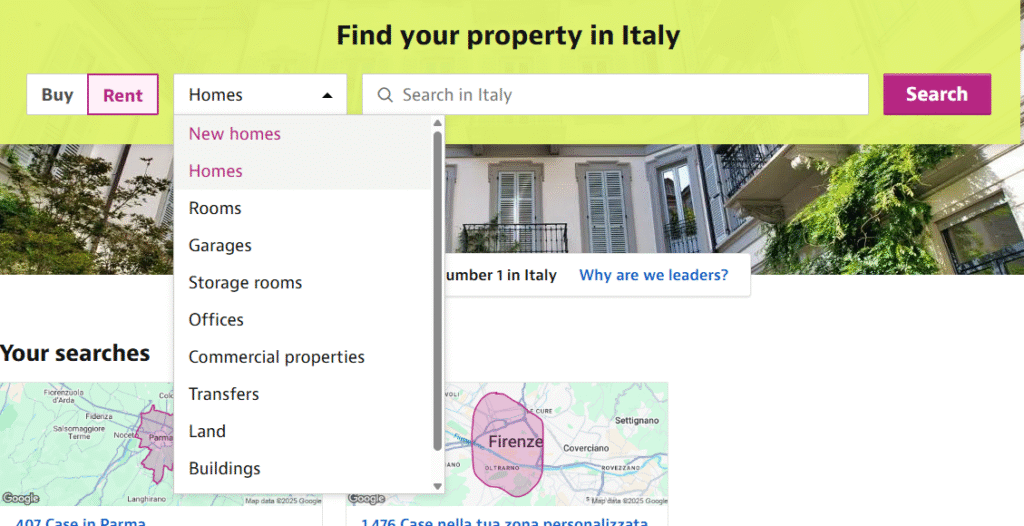
How does the research work? Let’s take for example Idealista.
Search IDEALISTA on Google and open the website.
On the bottom right (on laptop) choose your preferred language.
Now start your research going back to the top:
- Select Buy or Rent. In this case, Buy.
- Choose the type of property you’re looking for: Home, New Home, Land, Building.
- Select a location or draw your area (circle) on the map of Italy (for example, you can select a wide part of Central Italy if you’re exploring that region).
You then press Search and a list of properties will appear.
Sort by price, relevance, or most recent.
You can see main characteristics and features, or you can see where the house is located on the map.
Use the left menu to filter:
- number of rooms
- property type
- price
- house condition
- and additional options
Idealista includes both private sellers and real estate agents.
Recap:
- Go on Idealista
- Change language (bottom right)
- Select area or draw/circle your search zone
- Sort houses by relevance, price, or most recent
- Use filters: rooms, property type, price, conditions, etc.
Step 3 – Contact the seller
Once you see a house you like, contact the seller.
You can call them or send a private message.
You can also save your favourite properties by pressing the little heart next to the listing.
Sellers in Italy usually prefer phone calls. It feels more personal and shows you’re genuinely interested.
If you don’t speak Italian, it helps to have an Italian friend or a local expert who can make the first call and ask the basic questions for you.
After selecting around 10 promising houses, you can make your list of properties to visit.
Step 4 – Visit the property
Once you reach this step, you have two options:
- Plan a trip to Italy and visit the houses in person. Wonderful idea!
- OR (if you can’t go to Italy at this time) ask a trusted local expert or property consultant to visit them for you and give you a video tour.
If you visit them yourself, try not to see more than 3–4 houses per day.
It gets tiring and you won’t process the details clearly.
You don’t need a lawyer to buy in Italy, especially not at this stage.
What you might want is someone bilingual (Italian–English) to help with translations, explanations, and general guidance.
What to check during the visit
– Roof conditions
Tiles, beams, insulation, leaks.
The roof is one of the biggest expenses. If it’s in good condition, that’s a very good start.
– General structure
Wall thickness, cracks, floors, stairs, and overall stability.
Italian houses are often old and built with stone walls, great for temperature control but worth checking before deciding.
– Utility systems
Electric system, water system, and certifications.
Old houses often lack updated certificates. Don’t panic, but take note.
Electrical or plumbing works can become expensive too.
– Heating system
Different areas use different systems:
- Methane gas: common in towns and cities, but prices are rising.
- GPL tanks: used in the countryside, more expensive. It’s delivered by truck and you probably need to fill the tank once a year or more depending on how much you heat the house.
- Wood stoves or fireplaces: especially in lots of old stone houses. Older generations used to heat the house in winter only with a small wood stove. So you might feel super hot in the living room and kitchen and freezing cold in bathroom and bedrooms.
Today there are many advanced centralized wood or pellet stoves that send warm air into different rooms. You also have houses with a fireplace that warms maybe one room.
In any case, warmth always feels cozy and charming. But you need to purchase wood and know how to start it. And always remember you might not have the same temperature in every room. - Fire boilers: more complex machinery, they are used to heat the radiators evenly in the whole house.
Keep in mind that Italy is slowly moving toward green solutions, with incentives for heat pumps, solar panels, and other eco-friendly systems.
– Windows and doors
Replacing them can be expensive but they matter a lot for insulation and noise.
Please note: Italian windows open inwards, not upwards like in the US.
– Neighbours and shared roads
In Italy, shared private roads are common.
Always check if the access road is shared and with whom.
Step 5 – The final check
You’ve chosen your dream home.
Now you’re ready to make an offer.
In Italy, the first formal step is the “contratto preliminare”, a preliminary agreement where you officially express your intention to buy under certain conditions. The seller this way has made a formal agreement with you and can’t step back.
Before you sign, I strongly suggest you either decide to work with a local consultant to check the conditions of the house and do Due Diligence.
Or, if you prefer going through this process yourself, make sure to do a preliminary technical inspection with:
- Local Surveyor “geometra” to check paperwork, cadastral plans, map of the property, and verify that there are no illegal works, no hidden owners or shared parts of the property. He also will check land registry records, building permits, and certificate of habitability or RRE.
The surveyor will also provide an energy performance certificate or APE. - Local contractor or builder to check the conditions of roof and structure
- Local plumber to check the conditions of the water system
- Local electrician to check the conditions of the electric system and certifications
IN ITALY YOU DON’T NEED A LAWYER FOR THE PROCESS UNLESS YOU ARE WILLING TO HAVE ONE.
We work as local experts and consultants helping many foreign families going through all the process.
Step 6 – Preliminary contract
You can decide to appoint a special power of attorney or proceed yourself.
After doing all the Due Diligence, you will sign a preliminary contract which is a binding document where you commit to purchase the property.
What you need for buying is a mandatory CODICE FISCALE or TAX CODE DOCUMENT.
You also might want to open a bank account for all your bills and taxes, but this is not mandatory.
The preliminary contract can be completed privately or in front of a notary.
The preliminary contract means paying an agreed balance price on a specific date.
Step 7 – Final deed
It’s time to go in front of the notary for the final deed and signatures.
After signing the ROGITO the property is finally yours.
The notary reads out the names and residence of seller/s and buyer/s and the position and characteristics of the property. This final step only comes after a check of cadastral plans and after the Notary receives the APE Energy Performance Certificate.
All the parties involved must understand what the Notary is reading and saying. On the contrary, all documents need to be translated officially and read out in 2 languages so that everyone understands.
Most notaries nowadays speak very good English but not always.
Official translations can be expensive, so you could also opt for a Power of Attorney that speaks both Italian and your own language.
Finally, after everyone has signed the documents, the property passes hands together with keys and any related paperwork.
Step 8 – Relocation and utilities setup
What happens next? As you want to move into the property, whether it’s a holiday home or your main home, the first thing you want to think about is the setup of utilities. Water, electricity and heating providers depend a lot on the location.
Electricity main provider in Italy is Enel, but you might find other cheaper suppliers locally, so it’s up to you.
Gas and water depend on the local area in Italy and vary depending on your location.
Once everything is set up, you are ready to live in the house and, if necessary, start renovation works.
Cost of transaction
Total costs to buy a house in Italy vary approx. from 10% to 20% on the value of the house and you can divide them as follows:
- Cost of real estate agency 3–4% plus VAT (it can also vary to 5%) on the value of the property depending on the agency.
- Stamp duty or registration tax (Tassa di Imposta) 2% for first house and 9% for holiday or second home. That means if you live in Italy and it’s your first home you pay 2%; if instead it’s a second/holiday home you pay 9% on the cadastral value.
- Notary fee varies from 1–2% on the property value
- Property consultant cost
- Due diligence cost as pre-check before buying the house
- Official translator cost if necessary
- Mortgage % cost if necessary
Contact us for a consultation HERE.